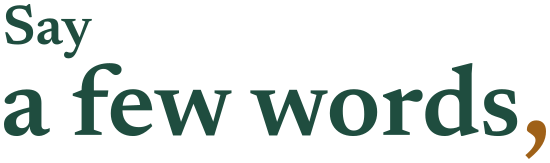
When you’ve been asked to say a few words,
we’ll help you find them. Talk to us about them for ten minutes, and you’ll have a eulogy that sounds like them, and a large-print copy to read from on the day.
Free to start. No card, no account. Read an example first.
- Talk or type
- Read the opening free
- £39 only if you want the rest
- Drafted by AI from your words
How it works
Talk to us about them
Tap the microphone and talk, or type. We listen, and now and then ask a little more, the way a celebrant would at your kitchen table. About ten minutes. Skip whatever you like.
Read how it begins
Tell us where to send it, and read the opening straight away. If it doesn’t sound like them, add a detail and we’ll write it again, free.
Make it yours
The full eulogy is £39, paid once. Two rounds of changes are included: tell us everything you’d like different, we ask about anything unclear, then rewrite. Then print your reading copy.
Why it sounds like them
We ask the way a good listener would
A eulogy is only as good as the memories in it. So this isn’t a form. Say they were stubborn and we’ll ask for a time they were. Tell us a story and we’ll ask what they said next. Those small true details are what the room will recognise.
Tap the microphone and say it the way you’d tell a friend. You may find you remember more out loud. If you’d rather type, type.
- You can see everything we’ve kept, at any time
- A few follow-up questions at most, and you can skip any of them
- Stop whenever you need to. It will be here when you come back
Nothing made up
Only what you told us
Every sentence of your eulogy has to come from something you said. The AI is told never to invent a name, a story or a fact, and a second check reads every draft against your answers before you see it.
And if two things you’ve told us don’t add up, a date or a number of years, we’ll check with you quietly, before anyone in the pews does the sum.
- Only what you tell us goes in. Nothing is made up
- Where something’s missing, it asks you
- You check every line before you use it
More than one voice
Ask the family for their memories too
Other people will remember things you don’t. Send a few people a private link. They write or say a paragraph, with nothing to sign up for. You read everything first, and for each memory we show you how it could go in.
1 · You ask

2 · They write, or say, a paragraph
3 · You choose how it goes in
Try them. Each shows how it would read, and how long it adds when spoken.
From our fictional sample. Nothing goes in unless you choose it. Asking the family is free, and it doesn’t use up a round of changes.
Making it right
Two rounds of changes, and questions first
Put everything you’d like different in one go, the way you’d say it to a friend: “add the caravan”, “too long”, “a gentler ending”. Before we rewrite, we ask about anything unclear, so the new version is right first time.
- A round is used when we rewrite it for you. Answering our questions, or adding family memories, never uses one
- What changed is underlined. Everything else stays exactly as it was, in case you’ve practised it
- Both versions are kept, so you can switch back at any time
Then, in the new version
For the day itself
A copy made for reading aloud
Writing it is half the worry. Standing up and reading it is the other half. So every eulogy comes with a reading copy:
- One breath to a line, so you never run out of air mid-sentence
- Pauses marked: / for a beat, // to let a moment land
- Names in bold, so you can look up and find your place again
- Large, clear print that works through tears and without your glasses
Look up at the end of a line, not the middle. Nobody minds a pause.
The last page of our fictional sample. It prints on A4 at 18 point. Fold it in three and it fits an inside pocket.
An example
In the school office she kept a biscuit tin, and there were no biscuits in it. It was full of gloves. Spare gloves, for the children who came in on cold mornings without any.
She never told anyone.
From a sample eulogy for “Dot”, written from a fictional set of answers so you can see what to expect. Read all of it.
Paid once. No subscription.
The conversation and the opening are free. You only pay if you want the rest.
The full eulogy
- In your voice, for 3, 5 or 7 minutes
- Two rounds of changes. We ask about anything unclear before we rewrite
- Your family’s memories, woven in the way you choose
- Large-print reading copy with pauses marked
- Yours to keep as a PDF and a Word document
£39
paid onceFull refund, no reason needed, up to 14 days after you pay.
Drafted by AI, working only from what you tell us.
Plainly
How it’s written
Your eulogy is drafted by AI, working only from what you tell us. It’s told never to invent a name, a story or a fact, and a second check reads every draft against your answers. Where something’s missing, it asks you. You check every line before you use it.
We say so plainly because you ought to know, and because it’s why this costs £39, where a professional writer often charges two hundred pounds or more. The memories are yours. The shaping is ours. The final word is always yours.
- What it does
- Asks about them, the way a celebrant would. Drafts the eulogy from your answers. Checks the draft against them, line by line.
- What it never does
- Invent a name, a story or a fact. Pretend to be a person. Learn from what you tell it: your words are not used to train AI.
- Where your words are kept
- Encrypted, in the UK. The AI model that drafts from them runs in the EU, under a contract that forbids using your words for training.
- How long for
- Deleted 30 days after your last visit, or 30 days after the funeral date you gave us if that is later. You can delete everything sooner from your private link, or by emailing us. The details are in our privacy notice.
Questions people ask
How long does it take?
It should take about ten minutes to talk it through. The opening is ready about a minute later. Funerals are usually two or three weeks away, so there’s time to come back, add things and read it aloud. If yours is tomorrow, there’s still time.
Can I really just talk?
Yes. Tap the microphone and say it the way you’d tell a friend. You may find you remember more out loud. You’ll see your words appear and can correct anything. If you’d rather type, type.
What if I don’t know what to say?
Half-sentences are fine. “He always had a mint in his pocket” is worth more than a paragraph of fine words. We’ll ask a little more where it helps, and you can skip any question after their name and yours.
Why do you ask for my email?
So we can send you a private link to open it on any device and print it at home. A new device asks for the six-digit code we email you. That’s all it’s used for. There are no newsletters. Reminders are off unless you ask for them. Two reminders at most, and one note the day before the funeral if you asked for it. None after the funeral.
Can my family add things?
Yes, and it’s free. Send a few people a private link by email, or copy a person’s link and send it to them yourself. They don’t need an account: they write or say a paragraph, it saves as they go, and they can come back and change it. Only you see what they send. For each memory we show you how it would read woven into what you say, as its own paragraph, or in their own words, and you choose. We email each person once, and once more only if you send a reminder. We never email them about anything else.
Will it sound like me, or like a greetings card?
Like you. It’s written for speaking, in plain British English, using your own phrases wherever it can. We keep a list of funeral clichés it isn’t allowed to use.
What if it isn’t right?
Two rounds of changes are included. Put everything you’d like different in one go; we’ll ask about anything unclear, then rewrite, and show you exactly what changed. If it still isn’t right, email us within 14 days of paying and we’ll refund you in full. You don’t need to give a reason.
What happens to what I tell you?
It’s used to write your eulogy and for nothing else. It isn’t used to train AI. It’s deleted 30 days after your last visit, or 30 days after the funeral date you gave us if that is later, or sooner if you ask. The details are in our privacy notice.
Can I use it for a memorial or a celebration of life? Or write it for someone else to read?
Yes to both. Say so in the last question and the tone, and the voice, will follow.
Start with their name.
The rest will come. We’ll help.
Free to start. No card, no account. Drafted by AI from your words.